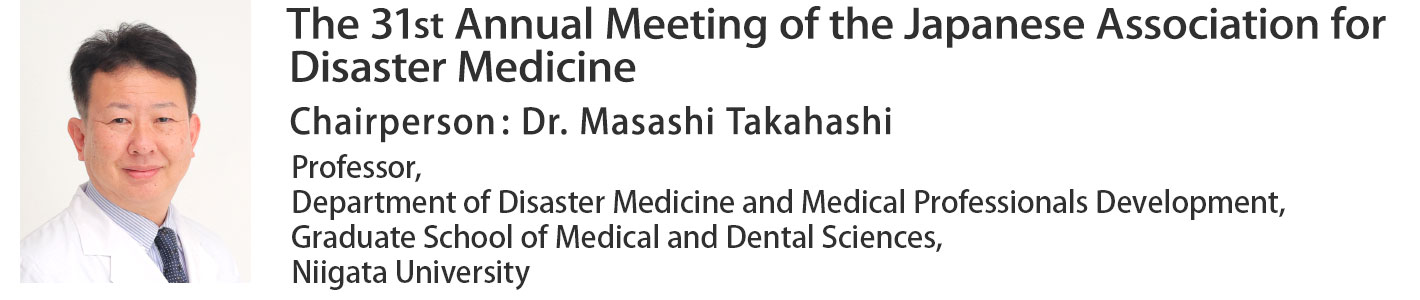
It is with great honor and enthusiasm that we announce the 31st Annual Meeting of the Japanese Association for Disaster Medicine, to be held over three days from Thursday, March 19 to Saturday, March 21, 2026, at the Toki Messe (Niigata Convention Center), located at the mouth of the Shinano River—the longest river in Japan— in the city of Niigata. The main theme of this conference is " From Experience to Evidence in Disaster Science." This marks a significant and long-cherished milestone for disaster medicine professionals in Niigata Prefecture, and we express our deepest gratitude for this invaluable opportunity to host the meeting.
One of the defining features of this academic conference is its multidisciplinary composition. Although it is a medical society, its members are not limited to physicians, but also include a wide range of professionals such as nurses, emergency medical technicians, public health officials, police officers, dietitians, firefighters, administrative personnel, and disaster response volunteers. This diversity reflects the collaborative nature of efforts to protect lives and health in times of disaster.
Another important characteristic of disaster medicine is its inherent unpredictability—no two disasters are ever the same. As a result, scientific inquiry into disaster medicine can be extremely challenging. Valuable experiences are often passed down merely as anecdotal accounts, with limited opportunities for formal analysis and application.
However, as a scientific and academic society, we believe it is our responsibility to support research, education, and practical implementation in disaster medicine as a form of social medicine. Our mission is to contribute to society through science.
With each disaster, valuable lessons are learned. By applying scientific methods to these experiences, we can build an evidence base that supports evidence-based education (human resource development), influence social systems, promote research such as the development of equipment and resources, and facilitate the implementation of these outcomes in real-world disaster responses. Through this, we aim to establish a dynamic, cyclical relationship between social practice and scientific progress. This academic meeting will focus on deepening discussions around the construction of such a model.
The year 2026 will also mark the 10th anniversary of the 2016 Kumamoto Earthquake. We have invited Professor Shunji Kasaoka of Kumamoto University to serve as Vice President of the meeting and will establish a Kumamoto-based organizing office to facilitate the planning of many sessions related to the Kumamoto Earthquake. In addition, we are grateful to have Dr. Yoichiro Domae, President of the Niigata Medical Association, and Dr. Yoshihisa Tsukada, Chairman of the JA Niigata Kouseiren, serve as Vice Presidents to highlight Niigata’s unique contributions to disaster medicine.
Niigata, having experienced the Chuetsu Earthquake and the Niigata Chuetsu Offshore Earthquake, and Kumamoto, having endured the Kumamoto Earthquake, will come together under the shared theme of “From Experience to Evidence in Disaster Science.” Together, we are diligently preparing for a meeting that fosters meaningful and vibrant discussions, accompanied by Niigata’s signature hospitality.
We sincerely look forward to welcoming you to Niigata, a historic port city, and to sharing this enriching experience with you all. |